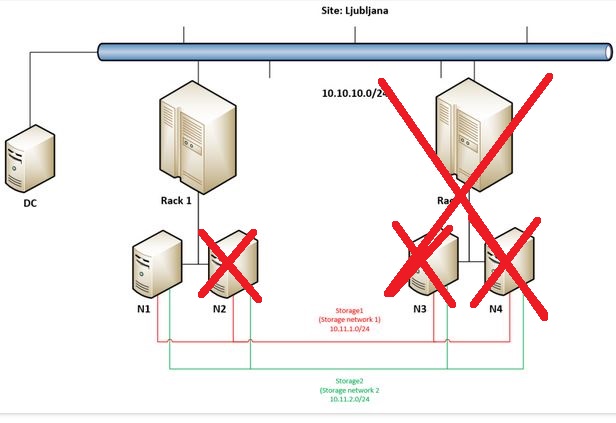
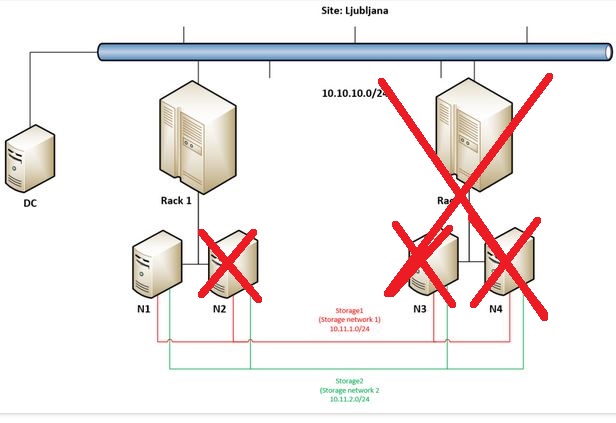
Again – probability of such scenario is in my opinion minimal but I just wanted to push our Campus Cluster to it’s limits – in previous post we have ended with this state:
When N2 went offline cluster immediately stopped working as there were not enough votes. In such case administrator has the option to make it run forcefully by “forcing quorum” and force start cluster service.
But let’s get back to the main idea why going into Campus Cluster scenario – to really have the option to built a very robust / resilient storage solution. This demo will demonstrate this robustness so we are going on by forcing remaining node in Rack 1 (N1) to start storage and VMs.
At the beginning of the video I am firing up Powershell on N1 as I need a cmdlet that will allow me to bring things online again:
Start-ClusterNode -Name N1 -FixQuorum
In couple of seconds we should get the information that node is in joining state.
I am turning on Failover Cluster Manager and on the left side in Actions you can see Start Cluster (I am trying that first 🙂 ) and Force Cluster Start – that will run with “ForceQuorum” option. We are getting many warnings at this point but it is a normal behavior in such state.
At 4:26 we can already see some Roles showing up, at 4:42 I am trying to turn off the machines that are in Paused-Critical in Hyper-V console … I made a mistake here – I forgot to move to Storage / Disks in Failover Cluster Manager where I should try to bring Cluster Shared Volumes online – when I did this (at 5:35).
While waiting for Virtual Machine Connection to connect to now running two VMs (those that were running on FourCopy Volumes I am jumping into Window Admin Center which is now showing data again – we can observe (at 8:29) that we have only 8 disks alive (of 32). At (8:56) we can see that both VMs are online – we are also able to log into them so the operating system works.
So we can see that Campus Cluster can be extremely redundant, resilient, robust in terms of protecting your data – and YES – you can get into running VMs even by forcing last remaining node to run cluster.
But and and just because we were already here…
At 10:21 I am showing that 8 disks are available in N1 (via Failover Cluster Manager / Storage / Pools) and at the end of this demo I am removing another disks from N1 – by doing so I am making everything going into paused state – CSVs are offline, VMs stop responding … But this part was made just for fun as you just can not get that unlucky. 🙂 Hope you have a backup because that is the only way get your data back from such disaster …
In this part I will try to go through a scenario with really low probability except if you are damn’ unlucky 🙂 I would like to show the resiliency of Storage Spaces Direct in Campus Cluster scenario so what we are going to showcase in this demo is:
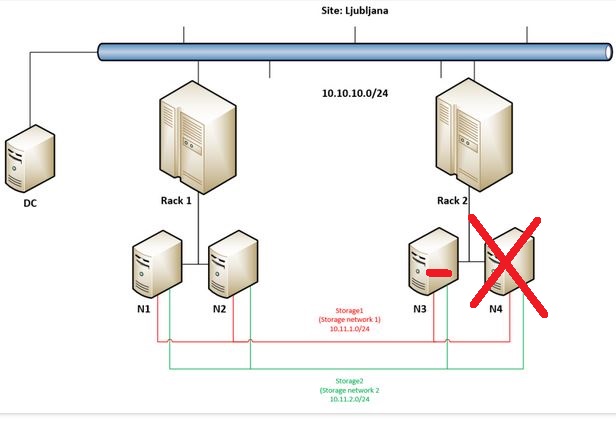
– first we will simulate failure of node 2 (N4) in Rack 2 – second – I will remove a healthy disk from node 1 (N3) in Rack 2 – third – I will simulate failure of second node (N3) in Rack 2 (the one that had one disk missing) – fourth – I will simulate failure of node 2 (N2) in Rack 1 – so the only “survivor” will be node 1 (N1) in Rack 1 that will not continue to work as it will remain in minority – we will cover that scenario in part 3. 🙂
In this part I am introducing also Windows Admin Center to have a better view (even with some delay 🙂 ) of what is going on in the cluster. So we are staring the scenario by checking Volumes via Windows Admin Center and getting through the disks that are available in our cluster (each of the four nodes have 8 disks dedicated to S2D solution).
At 0:53 I have done a dirty shutdown (Turn off) of N4 and you can see that it went into Isolated state before going into Down. And also virtual machine running on it went into Unmonitored state before being restarted on N2 (in Rack 1), so I am moving (by using Live Migration) it back to remaining node (N3) in Rack 2.
At 1:36 I am checking current situation with disks and I can see that only disks in N4 are missing (as that node is turned offf) but at 2:25 additional disk has “failed” in N3. But as we move to Volumes / Inventory we can see that all volumes are in state “Needs Repair” but with green checkmark so everything is still working and storage is available to workloads (VMs). I am also checking if VMs are online (I am pausing video for couple of seconds as VMC sometimes needs some time to show the console of the VM).
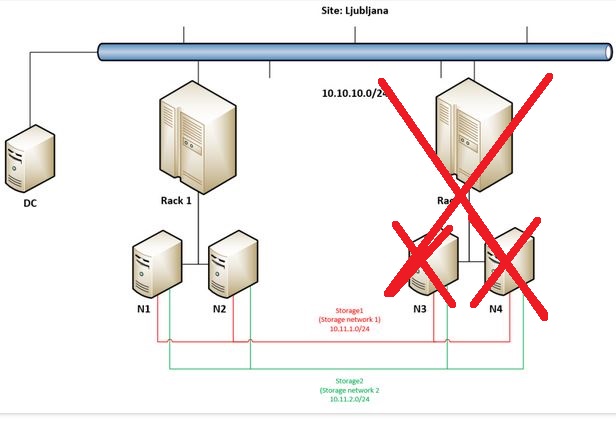
At 3:48 we can observe that also N3 so the remaining node in Rack 2 went offline (it become Isolated and later goes to status Down), VMs running on Rack 2 went into Unmonitored state and after approximately 10 seconds they are being restarted on nodes (N1 and N2) in Rack 1.
Everything is still working only all workloads (VMs) are now in Rack 1, and when I check Volumes / Inventory in Windows Admin Center we can still see that everything is green but needs repair. In Drives we can see that half of available disks are missing (16 of 32) – the same, even with more details it can be seen in Drives Inventory.
Our Sysadmin is extremely unlucky today: At approximately 4:58 another disastrous situation happen – N2 in Rack 1 fail. As there are four nodes in this cluster and there is only one node still available cluster stops working – you can see that I am not able to refresh Nodes or Roles in Failover Cluster Manager – Windows Admin Center is showing outdated situation as it can not connect to Cluster anymore.
So in this part we will end here – but as we have setup Four Copy Cluster Shared Volumes (you can check it here) there should be still some hope for our data (spoiler alert: Yes!)? Follow me to the next part.
In this first part I will go through the situation when one of two racks (in our case Rack 2) in our 4 node Campus Cluster scenario goes offline (simulating electricity or network connectivity outage …).
I am running 4 virtual machines (two small (MikroTik Cloud Hosted Router (CHR) and two a bit larger (Microsoft Azure Linux 3.0)) two in Rack 1 and two in Rack 2 on our Two Copy and Four Copy Cluster Shared Volumes – as can be seen at the beginning of the video.
What I am doing is this video is also reducing the timer of ResiliencyDefaultPeriod (which is by default set to 240 seconds (4 minutes)) to 10 seconds – as I do not want you to wait for 4 minutes to see my VMs coming online in Rack 1 🙂 I am reducing this timer also in production environments as I was (until now! 🙂 ) setting up mostly 2 node S2D clusters which are connected back to back, so waiting for 4 is in my oppinion a bit too long. Anyway, you can leave it also on default value.
At 1:25 I am dirty shutting down (Turn Off) nodes N3 and N4 (both in Rack 2) so you can see that machines in Rack 2 (on node N3) are going in Unmonitored state (for ten seconds (as defined by ResiliencyDefaultPerios) and in approximately at 1:36 they are restarted on nodes in Rack 1. We can also observe that nodes are down in Nodes tab in Failover Cluster Manager.
Next I wanted to show you that new background storage repair jobs are created which can be checked (on any node) by using Powershell cmdlet: Get-StorageJob
At 2:55 I am starting missing two nodes (N3 and N4 in Rack 2) again so we can see them joining the cluster again and in couple of seconds we can re-check storage jobs that are getting started (at 3:28) in the background and the data is re-synchronized between nodes from Rack 1 and Rack 2.
At 3:58 you can see that sometimes refresh makes problem to good old Failover Cluster Manager Console so I am just re-launching it again … At the end of the video you can see that all nodes are green again, we can move VMs back to Rack 2 and there are no background storage jobs waiting – it means that everything was handled correctly by Storage Spaces Direct.
And finally it is here! An update for Windows Server 2025 that we were waiting for and it is allowing us to create so called Campus Cluster. You can read more about it at the official Microsoft statement, here.
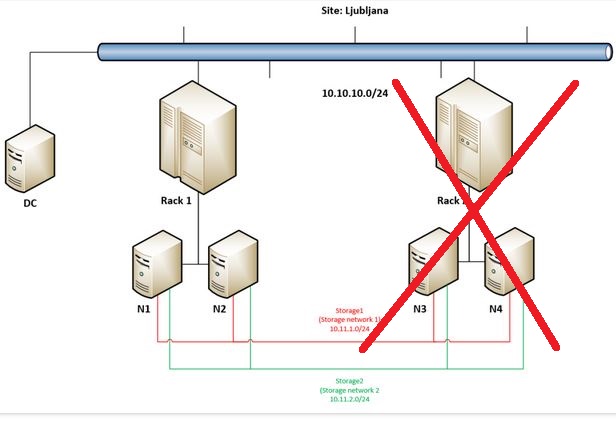
My demo setup looks like this – we have site called Ljubljana there are two racks Rack 1 and Rack 2 and in each rack we have two nodes (in Rack 1 we have N1 and N2 and in Rack 2 we have N3 and N4).
These four servers are domain joined (we have an extra VM called DC with Windows Server 2025 and Active Directory installed), they are connected to “LAN” network of the site with subnet 10.10.10.0/24 and each node has additional two network cards, one connected to a network that I call Storage network 1 with subnet 10.11.1.0/24 and Storage network 2 with subnet 10.11.2.0/24. Storage networks should be RDMA enabled (10, 25, 40, 100 Gbps) low latency, high bandwidth networks – don’t forget to enable Jumbo frames on them (if possible (it should be :))).
It looks like this:
To be able to setup hyper-converged infrastructure(HCI) with Storage Spaces Direct you need Failover Cluster feature and Hyper-V role installed on server. I am doing it via Powershell:
(This cmdlet will require reboot as Hyper-V is installed…) Enable-WindowsOptionalFeature -Online -FeatureName Microsoft-Hyper-V -All
When prerequisites are meet I will run cmdlet to form a cluster C1 with nodes N1-N4, with static IP address in the “LAN” segment and no storage (as I do not have any at this moment:
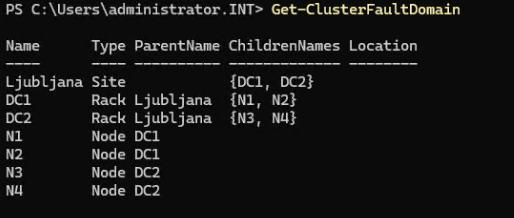
Before enabling Storage Spaces Direct you need to define Site, Racks and Nodes in those Racks. I have formed a typical site Ljubljana (Slovenian capital city) in that site I have created two racks in virtually two datacenters: DC1 and DC2 and I put those racks in site Ljubljana, then I added nodes in racks.
At the end you should have something like this if you go with Powershell cmdlet: Get-ClusterFaultDomain
When this is done you can proceed with enabling Storage Spaces Direct where you will be first asked if you want to perform this action (like every time when you enabled it until now) but coupe of seconds later you will be prompted again as now, system understood that we have site and racks and nodes in different racks.
Prompt will inform you that: Set rack fault tolerance on S2D pool. This is normally racommended on setups with multiple racks continue with Y (Yes).
In couple of seconds you can already observe newly created Cluster Pool 1 that will consist of all disks from all nodes (in my case 32 disks as every node has 8 disks dedicated for Storage Spaces Direct).
As by official documentation you should perform update storage pool by using Powershell cmdlet:
Get-StoragePool S2D* | Update-StoragePool
You will be prompted with information that StoragePool will be upgraded to latest version and that this is irreversible action – proceed with Y (Yes).
As we are expecting final release of Windows Server 2025 we can take a look at Stretched cluster capability in combination with Storage Spaces Direct (S2D).
In this quick demo I have setup a 4 node S2D stretched cluster between two Active Directory Sites and Services subnets (as Failover Cluster is using subnets in ADDS to determine in which site nodes are residing).
In my case I have Default First Site Name (Ljubljana) and another site called Portoroz. In Ljubljana our nodes are in segment 10.5.1.0/24 and in Portoroz in 10.5.2.0/24
We have two virtual machines located in a dedicated (stretched) VLAN (5) so they are in same subnet no matter on which node they are running.
Two VMs have IPs: 10.5.5.111 (vm1) and 10.5.5.112 (vm2) that I am live migrating to remote nodes (sitebn1 / sitebn2).
We have two options on how to deploy and use such scenario – we can use it in active / active mode so VMs and CSVs are on both sites and CSVs (synchronous) replicated to other pair of nodes. There is also the possibility to use it in active / passive mode so by just replicating CSVs from site 1 to site 2.
For demo purposes I have reduced the time that cluster starts its processes to establish availability of failed resources from 240 (4 minutes) seconds to 10 seconds. Value of 240 seconds is there since Windows Server 2016 and introduction of so called compute resiliency that allowed this 4 minutes for nodes to return from let say network outage or something like that. You can reduce this timer by using Powershell:
In the video you can see that I am live migrating VM first to site 2 and afterwards turning off the nodes in site 2. In around 15 seconds VM2 is available again this time on CSV (volume02) that was brought online on site 1.
I think this concept can be interesting for many customers and I am really looking forward for the final release of Windows Server 2025! Good job, Microsoft!
Yes, we are building clustered solutions to keep as high uptime as possible but sometimes there is a planned or unplanned electrical outage or maintenance work on power lines when we are simply forced to shutdown our cluster – and in that situation we want to do it safely.
When we talk about Storage Spaces Direct (S2D) on Windows Server 2016 / 2019 / 2022 in a hyper-converged scenario (when hyper-v virtualization and storage are inside the same system) it is very important to take care of properly shut down such system not to get in problematic situations where data corruption or some other issues could emerge. Becouse of that Microsoft has a great article about how to safely and properly shutdown a node in S2D configuration.
I would like to share with you a concept that could help you with getting whole cluster safely turned off.
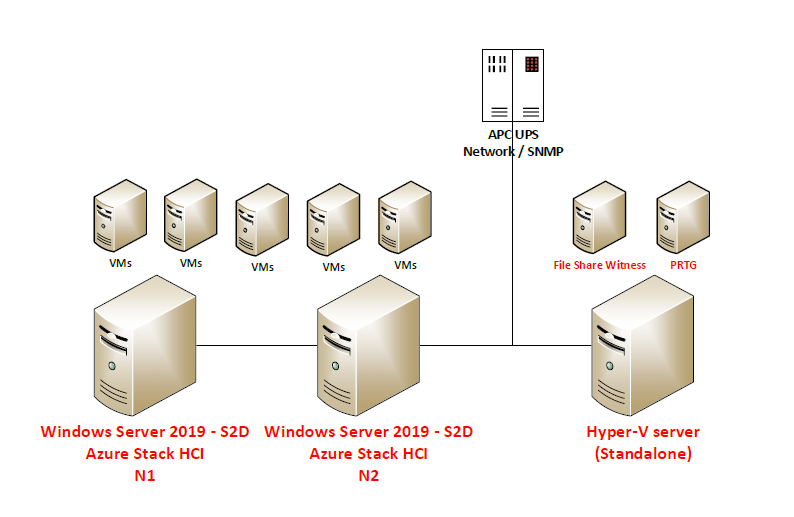
Scenario consists of 2-node S2D solution, standalone hyper-v (on which I run file share witness (for S2D)) and PRTG that by using SNMP monitors APC UPS 2200:
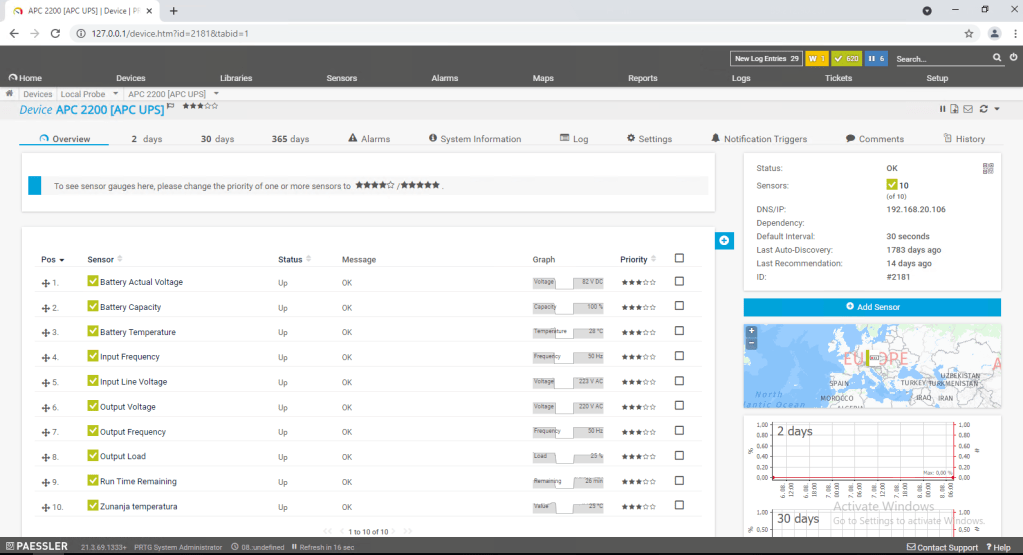
So first of all we need to get the information about Battery capacity by using SNMP query to APC Network management card – this will be the value that we will monitor and based on the current value we will trigger some actions.
Then we need to prepare Notifications templates where we define Powershell scripts to be executed. I am using three scripts: –First script will make a graceful stop of storage services and put S2D Cluster N2 in maintenance mode (all roles will be drained to S2D Cluster N1) after that it will shut down S2D Cluster N2 –Second script will trigger shutdown of all virtual machines on S2D Cluster N1 and after 180 seconds it will shut down the S2D Cluster N1 – Third script will shut down third hyper-v host (standalone)
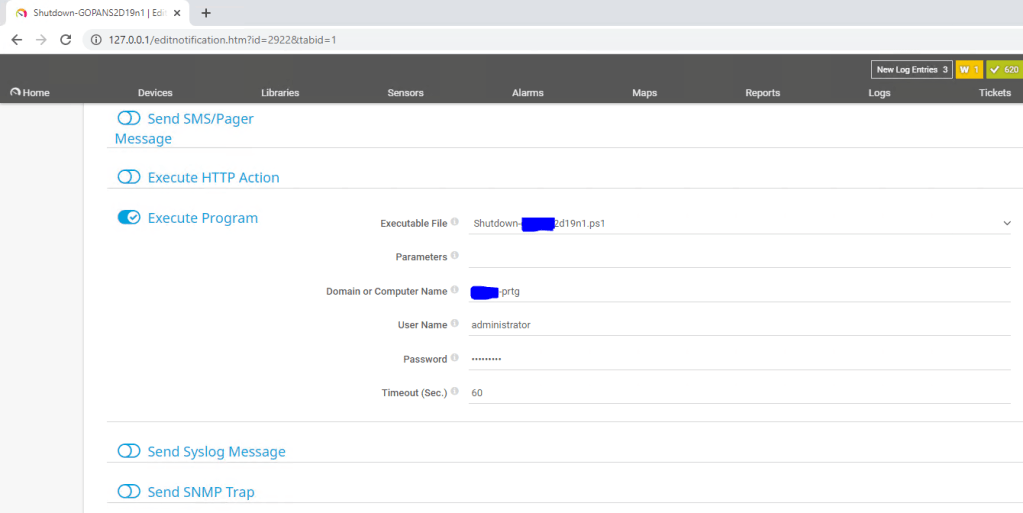
With the action Execute Program on our Notification Template we define which script we would like template to use and username and password that will be used only to execute the script on local machine (PRTG) – credentials for powershell remoting that will do the shutdown jobs can be safely saved separately so you do not need to enter plain-text credentials to access the hosts anywhere.
After that we need to configure triggers – when scripts will be executed based on the battery capacity – so in my case I decided to set it up like this:
When battery is on 65% turn off S2D Cluster N2 (drain roles (VMs and cluster service roles to S2D Cluster N1), put the node in maintenance mode, shut down the physical node S2D Cluster N2).
When battery is on 45% turn off S2D Cluster N1 by firs shutting down all VMs, than wait 180 seconds for shutdown to complete and then shut down physical S2D Cluster N1.
When battery is on 15% turn off standalone Hyper-V host – where our Witness and PRTG VMs are running
If we check the scriptblocks inside our scripts:
Shutdown-N2.ps1 (the script that in my case we will run first):
In first part of the script we need to setup credentials that will be used to execute powershell remoting: You can do this buy simply entering username and password into the script (Please do not do that! Powershell allows you to do it way more securely. Please read this article about securely saving encrypted password in separate file.
So the shutdown sequence will be: – when electricity is turned off and PRTG gets the info by querying UPS that capacity of the battery is under 65 %: S2D Cluster – N2 will bi gracefully stopped (by draining roles and putting it in maintenance mode and shutdown after that) – when the battery is under 45 %: S2D cluster – N1 will be gracefully stopped (by shutting down all VMs and finally shutting down) – when the battery capacity is under 15 %: Our standalone host (where PRTG and File Share Witness (needed for S2D Cluster)) will be shutdown.
The procedure to turn the system back on is the following: – First we will turn on standalone host (and Files Share Witness VM) – Please do not turn on PRTG server until UPS battery capacity is not over 65% (because PRTG will turn on the procedures again if capacity is below 65%) – When you checked that standalone host has network connectivity and File Share Witness VM is working and has connectivity too we can proceed further by turning on S2D Cluster N1 – When S2D Cluster N1 is up we can turn on VMs* (as Witness is there and N1 is fully functional you are able to start your production VMs – there will be more data to resync so if you have time it is better to wait for N2 to get back online and put it out of maintenance mode.) – We can now turn on S2D Cluster N2 and when it comes back online we need to bring it back into fully functional Cluster member state by executing the script:
I have two node Storage spaces direct scenario and after updating and rebooting one of the nodes in cluster I need to wait storage operations to complete (yes I am updating this scenario manualy :)).
If you want to check the progresss of this synchronization / repair of Storage spaces just drop this in Powershell on one of the nodes:
Get-StorageJob | Select Name,IsBackgroundTask,ElapsedTime,JobState,PercentComplete,@{label=”BytesProcessed (GB)”;expression={$_.BytesProcessed/1GB}},@{label=”Total Size (GB)”;expression={$_.BytesTotal/1GB}} | ft
You should get something like that…
Remember – if you have Storage spaces direct in two-node scenario you SHOULD WAIT for this job to complete – if you reboot second node to soon your CSV will go offline! So keep calm and Powershell! 🙂
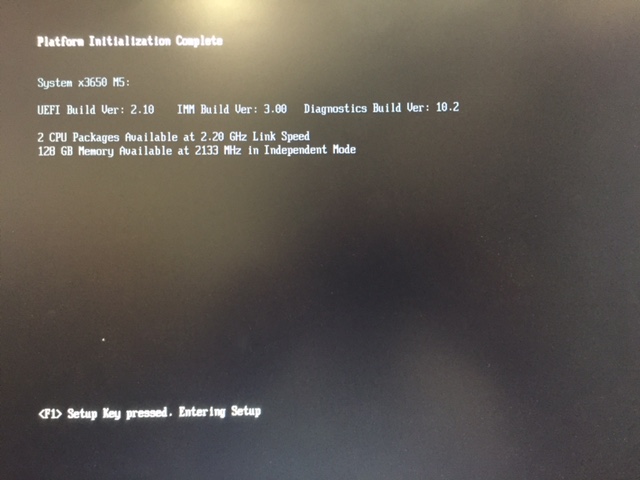
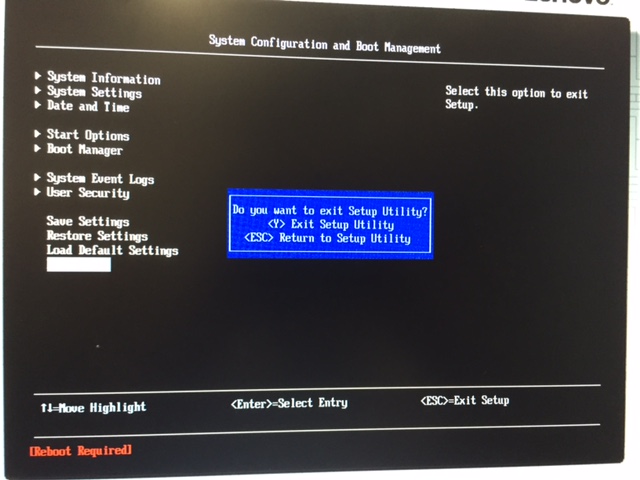
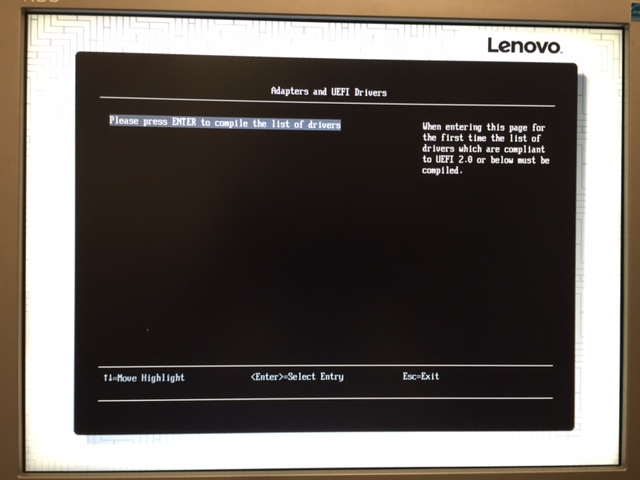
Recently I wanted to use disks connected to M5210 raid controller as JBOD…
My controller has also additional cache and battery pack and in this configuration you are getting the error “The requested command has invalid arguments.” when trying to Apply change to JBOD…
well… If you physical remove the cache from your controller…
…and a reboot… you will be able to enable JBOD mode…
…finaly in Windows – disk manager you can see your disks…
Important NOTE for those that would like to test Storage Spaces Direct technology that is comming with Windows Server 2016 (currently TP5)!
This will not work as BUS TYPE is still RAID and this is not supported – it should be SAS. The setup will fail at the step Enable-ClusterStorageSpacesDirect
The only solution is to buy a simple HBA as written here.
“…All SATA and SAS devices must be attached to a SAS Host Bus Adapter (HBA). This HBA must be a “simple” HBA, which means the devices shows as SAS devices in Windows Server…”












 Luka Manojlovic